Vectors are used to group related signals using one name to make it more convenient to manipulate. For example, wire [7:0] w; declares an 8-bit vector named w that is equivalent to having 8 separate wires. 向量用于通过一个名称对相关信号进行分组,以更方便地对其进行操作。例如,wire [7:0] w; 声明了一个名为 w 的 8 位向量,这相当于拥有 8 根独立的导线。
Declaring Vectors
Vectors must be declared: 向量必须这样声明:
type [upper:lower] vector_name;
type specifies the datatype of the vector. This is usually wire or reg. If you are declaring a input or output port, the type can additionally include the port type (e.g., input or output) as well. Some examples: type 指定了向量的数据类型。通常为 wire 或 reg。如果声明的是输入或输出端口,类型还可额外包含端口类型(例如 input 或 output)。示例如下:


The endianness (or, informally, "direction") of a vector is whether the the least significant bit has a lower index (little-endian, e.g., [3:0]) or a higher index (big-endian, e.g., [0:3]). In Verilog, once a vector is declared with a particular endianness, it must always be used the same way. e.g., writing vec[0:3] when vec is declared wire [3:0] vec; is illegal. Being consistent with endianness is good practice, as weird bugs occur if vectors of different endianness are assigned or used together. 向量的字节序(通俗也可称为“方向”)指的是最低有效位对应的索引更小(小端序,例如 [3:0])还是更大(大端序,例如 [0:3])。在 Verilog 中,一旦向量以特定的字节序声明,就必须始终以相同的方式使用。例如,若 vec 被声明为 wire [3:0] vec;,却写入 vec[0:3],这是非法的。保持字节序一致是良好的编程习惯,因为如果将不同字节序的向量赋值或一起使用,会出现奇怪的错误。
Implicit nets 隐式线网
Implicit nets are often a source of hard-to-detect bugs. In Verilog, net-type signals can be implicitly created by an assign statement or by attaching something undeclared to a module port. Implicit nets are always one-bit wires and causes bugs if you had intended to use a vector. Disabling creation of implicit nets can be done using the `default_nettype none directive. 隐式网络通常是难以检测的错误的来源。在 Verilog 中,网络类型信号可通过 assign 语句或通过将未声明的内容附加到模块端口来隐式创建。隐式网络始终是一位线网,若你打算使用向量则会引发错误。可使用 `default_nettype none 指令禁用隐式网络的创建。

 Adding
 `default_nettype none would make the third line of code an error, which makes the bug more visible. 添加 `default_nettype none 会使代码的第三行报错,从而让这个 bug 更容易被发现。
==Verilog 的“默认规则”:Verilog 中,在任何地方使用一个未事先声明的变量名,综合工具会自动帮你隐式创建一个 wire 类型信号。== ==b 从未声明,触发隐式网络规则 → 自动生成一个 1 位的 wire b== ==3 位 a 赋值给 1 位 b → 发生截断,只保留最低位 1(二进制 101 的最低位是 1)== ==所以 b 实际值是 1'b1==
==my_module i1 (d,e); 这句话的"不对"之处==
- ==
d和e这两个信号名在之前没有出现过== - ==根据隐式网络规则,编译器会自动创建两个 1 位的
wire信号,分别叫d和e== - ==然后把
my_module的第一个端口连到d,第二个端口连到e==
Unpacked vs. Packed Arrays 非压缩数组与压缩数组
You may have noticed that in declarations, the vector indices are written before the vector name. This declares the "packed" dimensions of the array, where the bits are "packed" together into a blob (this is relevant in a simulator, but not in hardware). The unpacked dimensions are declared after the name. They are generally used to declare memory arrays. Since ECE253 didn't cover memory arrays, we have not used packed arrays in this course. See http://www.asic-world.com/systemverilog/data_types10.html for more details. 你可能已经注意到,在声明中,向量索引写在向量名称之前。这声明了数组的“压缩”维度,其中各位被“压缩”成一个数据块(这在模拟器中有效,但在硬件中不适用)。解压缩维度则写在名称之后。它们通常用于声明存储器数组。由于 ECE253 课程未涉及存储器数组,因此我们在本课程中没有使用压缩数组。有关更多详细信息,请参见网址


Accessing Vector Elements: Part-Select访问向量元素:部分选择
Accessing an entire vector is done using the vector name. For example: 通过向量名来访问整个向量。例如:
assign w = a;
takes the entire 4-bit vector a and assigns it to the entire 8-bit vector w (declarations are taken from above). If the lengths of the right and left sides don't match, it is zero-extended or truncated as appropriate. 获取整个4位向量a,并将其赋值给整个8位向量w(声明来自上文)。若右侧和左侧的位数不匹配,则相应地进行零扩展或截断操作。
The part-select operator can be used to access a portion of a vector: 部分选择运算符可用于访问向量的某一部分: 

- ==
b[3:0]是非法的,因为你的向量b很可能是声明为[0:3]这种升序方向的,而[3:0]是降序方向,与声明方向不匹配。== - ==
b[0:3]是合法的,它选取的是b的高 4 位(如果b声明为[0:3])==。
A Bit of Practice 一点小练习
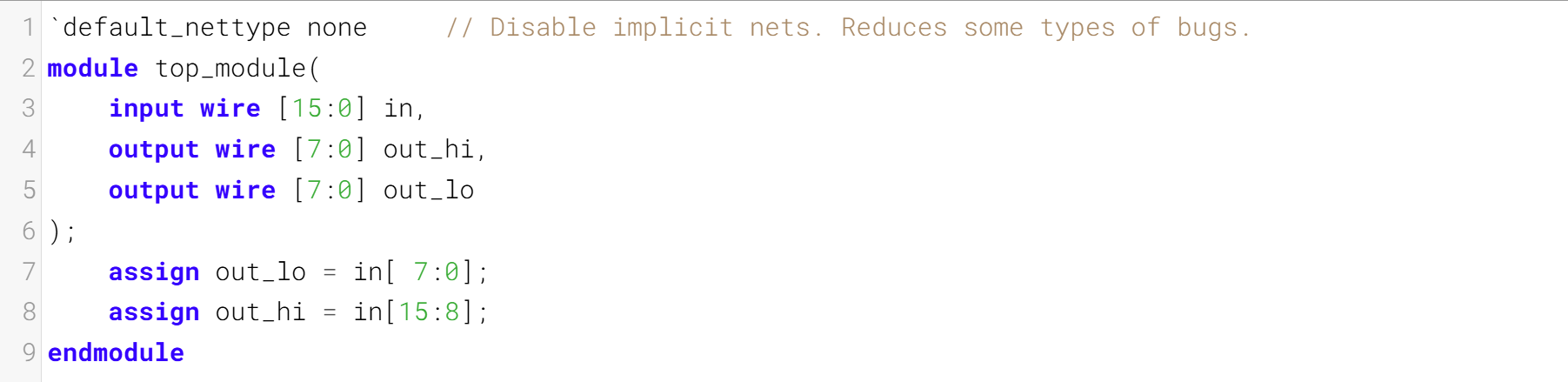
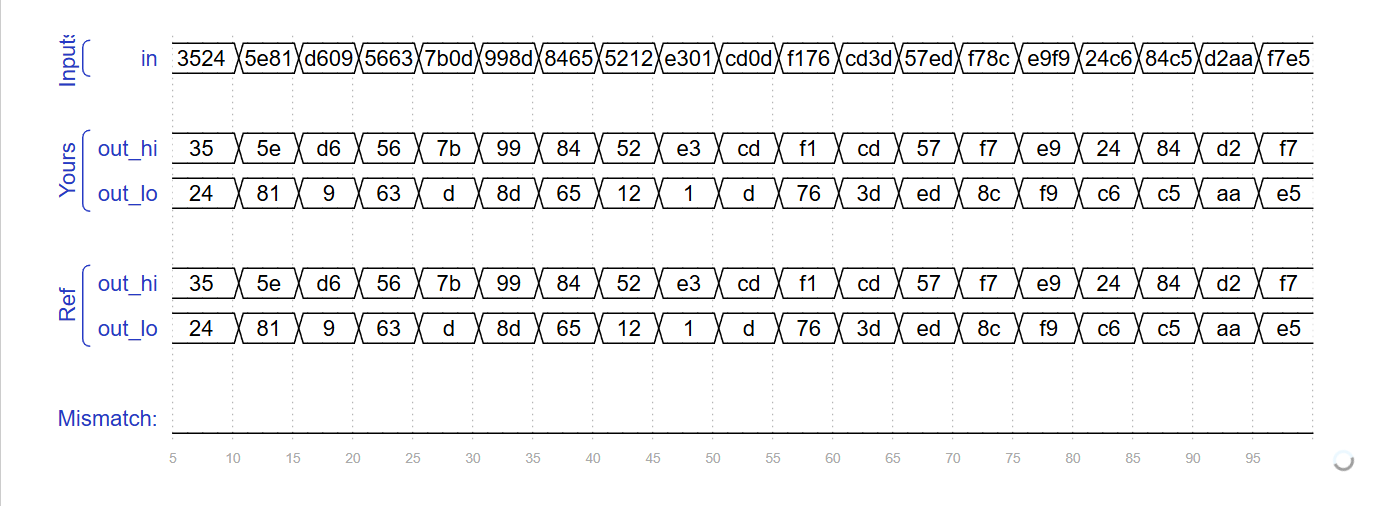
Build a combinational circuit that splits an input half-word (16 bits, [15:0] ) into lower [7:0] and upper [15:8] bytes. 构建一个组合电路,将一个输入的半字(16位,[15:0])拆分为低[7:0]字节和高[15:8]字节。
Module Declaration


Write your solution here


Solution
方法一: 
 方法二:
方法二: 

Timing diagrams

贡献者
 dz13718198068