You're already familiar with bitwise operations between two values, e.g., a & b or a ^ b. Sometimes, you want to create a wide gate that operates on all of the bits of one vector, like (a[0] & a[1] & a[2] & a[3] ... ), which gets tedious if the vector is long. 你已经熟悉两个值之间的按位运算,例如 a & b 或 a ^ b。有时你需要创建一个宽门电路,对一个向量的所有位进行运算,比如 (a[0] & a[1] & a[2] & a[3] ... ),如果向量很长,这种写法会非常繁琐。
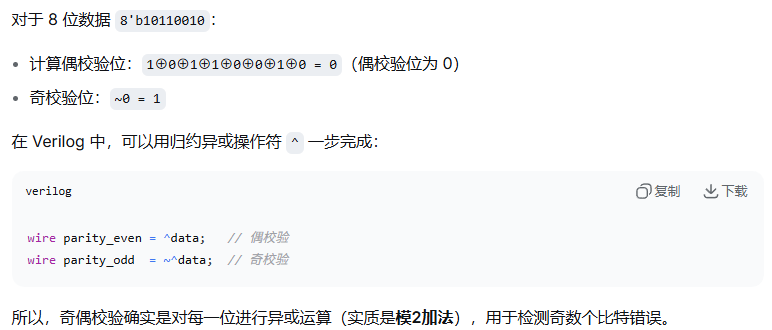
The reduction operators can do AND, OR, and XOR of the bits of a vector, producing one bit of output: 归约运算符可对向量的各位进行与、或和异或运算,输出一位结果:


These are unary operators that have only one operand (similar to the NOT operators ! and ~). You can also invert the outputs of these to create NAND, NOR, and XNOR gates, e.g., (~& d[7:0]). 这些是仅带有一个操作数的一元运算符(类似于非运算符! 和 ~)。你也可以对这些运算符的输出取反,以构建与非门、或非门和异或非门,例如 (~& d[7:0])。
Now you can revisit 4-input gates and 100-input gates. 现在你可以重新回顾4输入门和100输入门。
A Bit of Practice 一点练习
Parity checking is often used as a simple method of detecting errors when transmitting data through an imperfect channel. Create a circuit that will compute a parity bit for a 8-bit byte (which will add a 9th bit to the byte). We will use "even" parity, where the parity bit is just the XOR of all 8 data bits. 奇偶校验常被用作在非理想信道中传输数据时检测错误的简单方法。请设计一个电路,用于计算8位字节的奇偶校验位(这会为该字节增加第9位)。我们将使用“偶”校验,其中校验位就是全部8个数据位的异或结果。
Expected solution length: Around 1 line. 预期的解决方案长度:大约一行。
Module Declaration


Write your solution here


Solution
module top_module (
    input [7:0] in,
    output parity
);
    assign parity = ^ in[7:0];
endmodule
贡献者
 dz13718198068