Part selection was used to select portions of a vector. The concatenation operator {a,b,c} is used to create larger vectors by concatenating smaller portions of a vector together. 部分选择用于选择向量的部分内容。拼接运算符 {a,b,c} 用于通过将向量的较小部分拼接在一起来创建更大的向量。 

Concatenation needs to know the width of every component (or how would you know the length of the result?). Thus, {1, 2, 3} is illegal and results in the error message: unsized constants are not allowed in concatenations. 拼接操作需要知道每个组件的宽度(否则如何得知结果的长度?)。因此,{1, 2, 3} 是非法的,会产生错误信息:拼接操作中不允许使用未指定大小的常量。
The concatenation operator can be used on both the left and right sides of assignments. 拼接运算符可用于赋值语句的左侧和右侧。


A Bit of Practice
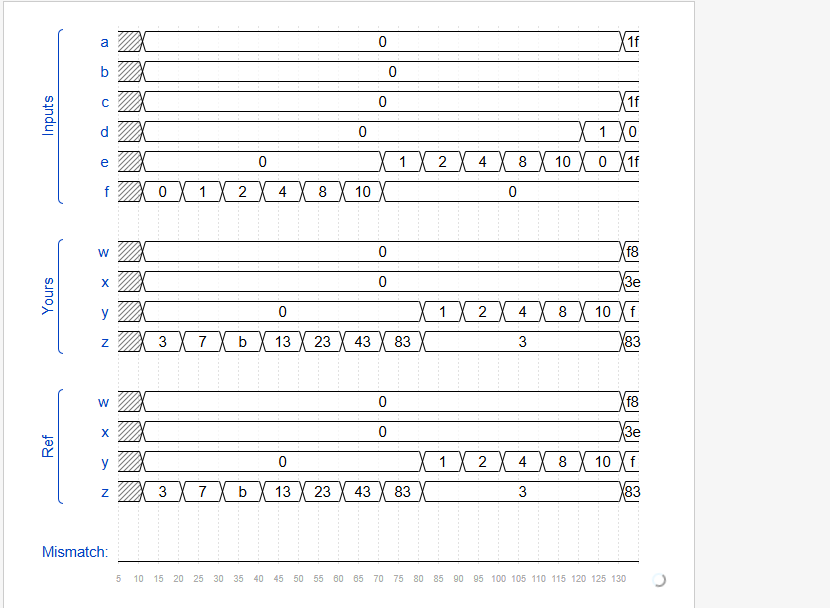
Given several input vectors, concatenate them together then split them up into several output vectors. There are six 5-bit input vectors: a, b, c, d, e, and f, for a total of 30 bits of input. There are four 8-bit output vectors: w, x, y, and z, for 32 bits of output. The output should be a concatenation of the input vectors followed by two 1 bits: 给定若干输入向量,将它们拼接在一起后再拆分为多个输出向量。存在六个5位输入向量:a、b、c、d、e和f,总计30位输入。存在四个8位输出向量:w、x、y和z,共32位输出。输出应为输入向量的拼接结果后紧跟两个1位: 

Module Declaration


Write your solution here


Solution
==直接拼接即可== 

Timing diagrams

贡献者
 dz13718198068